
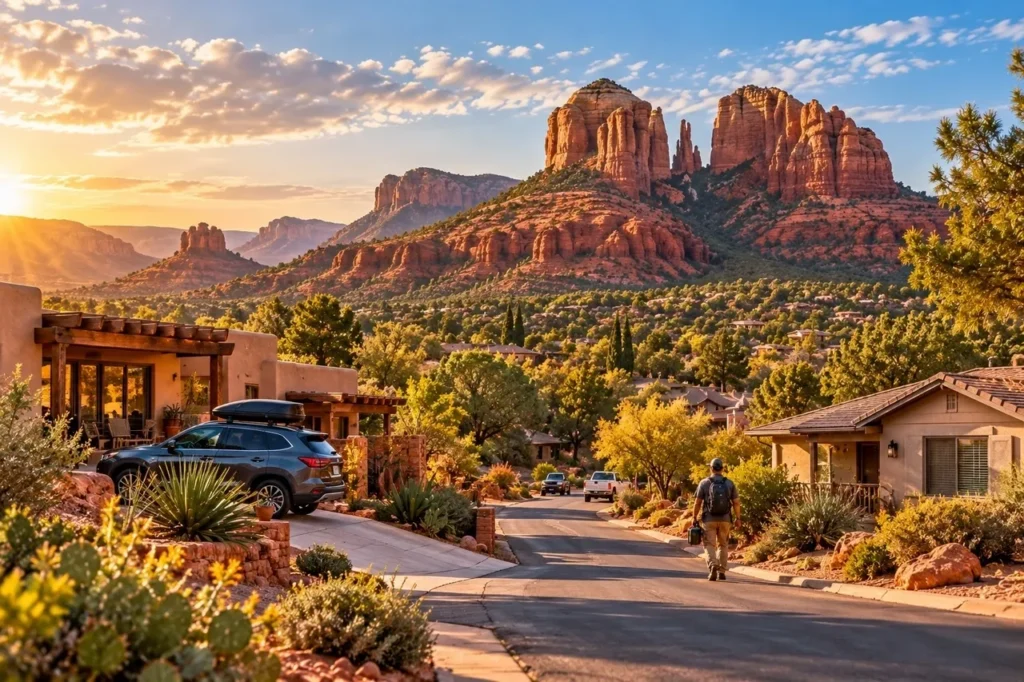
Contributed by Jim & May Johnson
It’s a strange problem to have: People love your town so much that the people who live there struggle to stay.
That’s the concern explored in a video about Sedona, Arizona, where beautiful red rocks and a thriving tourism business come with some difficult questions about housing, property rights and what makes a community a community.
Could any of this apply to Mesquite?
We’re a different town, with different circumstances. But the question is worth asking before a problem becomes a predicament.
Visitors Bring Business and Some Tradeoffs
Tourism puts money into a town. Visitors eat at restaurants, shop in stores, book rooms and support jobs. For business owners, those customers can make the difference between keeping the doors open and closing them.
Vacation rentals are part of that economy. They give travelers more choices and give homeowners a way to earn income, cover expenses or make use of a home they occupy only part of the year.
But there’s another side.
When a house becomes a vacation rental, it may no longer be available to someone looking for a year-round home. In a community with limited housing, enough of those conversions can put pressure on workers and families.
Sedona’s own housing program reports that more than 18% of its housing inventory has been converted to short-term rentals. The city offers financial incentives to encourage some owners to rent to local workers instead.
Visitors need people to prepare their meals, clean their rooms and keep the town running. Those people need somewhere to live, too.
Whose House? Whose Neighborhood?
For property owners, the argument is straightforward: They bought the house, pay the bills and carry the risk. Shouldn’t they have some say in how they use it?
A vacation rental isn’t automatically a problem property. Responsible owners can maintain their homes, set rules for guests and contribute to the local economy. Restricting everyone because of a few bad operators can feel unfair.
Neighbors have a reasonable argument as well.
They bought a home expecting a residential neighborhood. A steady rotation of visitors can mean unfamiliar cars, noise and fewer familiar faces. Even when guests behave themselves, a street can feel different when fewer people actually live there.
Both concerns deserve a fair hearing. Property rights matter. So does being able to enjoy your own home.
Arizona’s 2016 law prevented cities from banning short-term rentals outright, while allowing certain health, safety and nuisance regulations. That limited Sedona’s ability to decide the issue locally.
Vacation Rentals Aren’t the Whole Story
It would be too easy to blame every housing problem on tourists.
Housing costs also depend on how many homes are available, what they cost to build and what local jobs pay. Restricting vacation rentals doesn’t guarantee that those houses will become affordable rentals. Owners might sell them, keep them as second homes or simply stop renting.
That leaves room for other ideas: more housing choices, fewer unnecessary obstacles to construction, employer partnerships and voluntary incentives for long-term rentals.
Sedona’s housing debate became especially striking in 2024, when its City Council approved a proposed overnight parking site for local workers living in vehicles. Voters later rejected the zoning change needed for that site. It should not be mistaken for an operating program.
Whatever someone thinks of that proposal, it raises a sobering question: What happens when a town needs workers but those workers can’t find a place to live?
What About Mesquite?
Mesquite benefits from visitors, seasonal residents and people discovering our little corner of the desert. They support businesses and bring opportunities.
We also want Mesquite to remain a place where people can put down roots, work, raise families and know their neighbors.
Sedona’s experience doesn’t prove we have the same problems. It gives us a reason to ask useful questions:
- Can people working in Mesquite afford housing here?
- How much of our housing serves year-round residents, seasonal residents and vacation guests?
- Are neighborhood complaints isolated problems or signs of something broader?
- Could we address concerns by enforcing existing rules and expanding housing choices?
Before choosing a solution, we ought to understand the local facts.
Nobody wants to chase away the customers who keep businesses going. Nobody wants to discover that the people serving those customers can no longer afford to live nearby, either.
What do you think? Should Mesquite place more limits on vacation rentals, protect owners’ freedom to rent, or focus on creating more housing, and where would you draw the line?
Watch the Sedona story that inspired this conversation on YouTube.