
Submitted by the Team at The VVV
First, a quick show of hands: are you sitting on a mortgage rate you’ll never give up?
If you locked in at 3% back in the day, you know the feeling. Maybe you’ve thought about moving. Maybe the kids are gone and the house feels too big, or maybe you need more room. Then you run the numbers on a new house, wince and close the laptop.
What’s your rate, and would you move if you could keep it? We have a hunch a lot of you are in the same boat.
What I’m seeing out here in the wild
A quick note before we dive into this: this piece comes from my own experience working with sellers (my speciality), not from a national study. I can only speak to what crosses my desk. And what’s crossing my desk has been pretty consistent.
When people talk about why it’s so hard to afford a house, the conversation usually jumps to one of a few boogeymen. Californians showing up with all-cash offers. Investors (foreign and domestic) buying homes out from under families. Short-term rentals swallowing up the neighborhood. Those stories get a lot of airtime, and I’m not saying they never happen.
But in my day-to-day work, they’re not even in the top three problems. What I see over and over is simpler, and way more frustrating: owners who would love to move, but can’t stomach the numbers. Sellers who want to downsize and walk away from the conversation once they see that a smaller house would cost more than the one they’ve already got. Families who’ve outgrown their starter home and decide to stay “one more year.” Or retirees whose kids are grown, or who’ve just gotten weary of maintaining a big home now that they’re older. Home sales that aren’t happening.
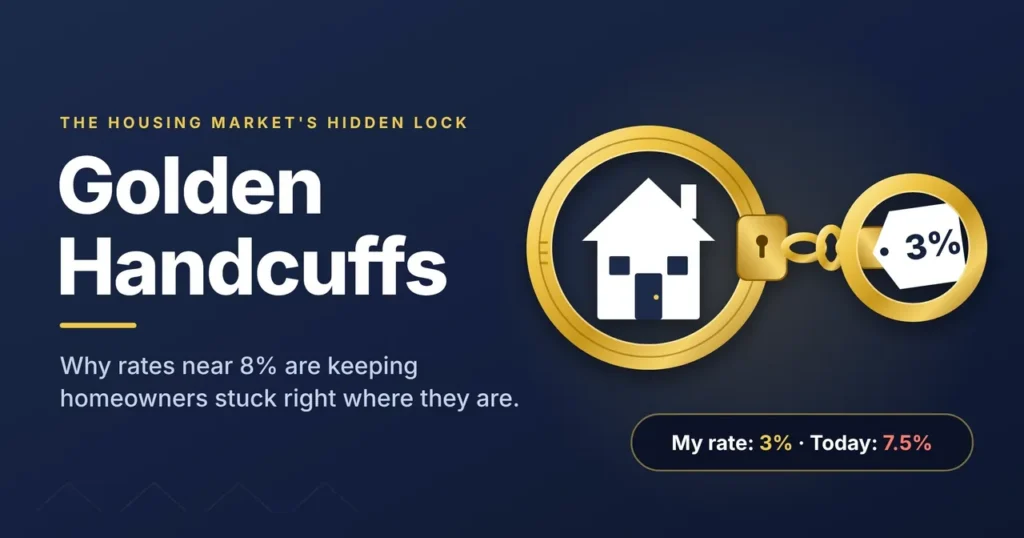
That’s what we call “golden handcuffs.” And with rates jumping again, it’s one of the biggest problems I’m seeing.
Another month – another rate hike
Mortgage rates just jumped to about 7.5%, the highest in three years (Bankrate). A month ago they were under 7%.
Why? In short, inflation. Prices are still rising, oil spiked after the war with Iran began, and when inflation sticks around, borrowing gets more expensive. Buyers are already pulling back, and some economists say 8% could be next.
Will rates come back down soon? The Treasury Secretary says yes, once the war ends. The Fed isn’t so sure. Either way, don’t count on relief anytime soon.
The golden handcuffs, by the numbers
Here’s the math behind the conversations I keep having, and why this rate spike hurts.
About half of all U.S. mortgages carry a rate below 4%, and roughly one in five is below 3%, according to FHFA data for early 2026. Those owners aren’t just reluctant to sell. For many of them, moving makes no financial sense at all.
Take an example couple. Their numbers are made up, but their situation is one I see all the time. In 2020 they bought a 2,000-square-foot house for $300,000, put 10% down, and locked in at 3%. The kids are grown, and they’d love something smaller. Here’s what that move looks like today:
STAY PUT vs. DOWNSIZE
STAY PUT
Home: 2,000 sq ft, worth ~$450,000
Loan balance: ~$233,500
Rate: 3%
Monthly principal & interest: ~$1,138
DOWNSIZE
Home: 1,400 sq ft, priced at $400,000
Loan balance: ~$210,500 (after rolling in ~$190,000 of equity)
Rate: 7.53%
Monthly principal & interest: ~$1,476
Read that again. They’d sell, pay roughly $27,000 in selling costs, move into a house 600 square feet smaller, and pay about $340 more every month for the privilege. At 8%, it’s closer to $410 more. And in many states, property taxes reset higher on the new purchase price, making it worse still.
So they stay. Not out of stubbornness, but because the math tells them to. That’s the golden handcuffs: a great deal you can’t walk away from, even when your life doesn’t fit your house anymore.
And it’s even worse for growing families
Now flip it around. Take a young family (again, made-up numbers, but a situation I see constantly). In 2021 they bought a $250,000 starter home with 3.5% down at 3%. Today it’s worth about $320,000. A second baby is on the way, and they need more room. The house they want costs $450,000.
STAY PUT vs. MOVE UP
STAY PUT
Home: Starter home, worth ~$320,000
Loan balance: ~$214,500
Rate: 3%
Monthly principal & interest: ~$1,017
MOVE UP
Home: Bigger home, $450,000
Loan balance: ~$364,000 (after rolling in ~$86,000 of equity)
Rate: 7.5%
Monthly principal & interest: ~$2,543
That’s not a bump. Their loan grows by about 70%, their rate more than doubles, and their payment is two and a half times higher, up about $1,500 a month. At 8%, it’s closer to $2,670. Most young families’ budgets simply can’t absorb that, so they stay put, squeeze into the starter home, and that starter home never comes up for sale for the next first-time buyer.
Everybody’s stuck, just in different places
The handcuffs don’t just trap the person wearing them. They jam up the whole chain.
Empty-nesters stay in more house than they want or need, paying to heat, clean, and maintain bedrooms nobody sleeps in.
Growing families can’t find the three- and four-bedroom homes those empty-nesters are sitting in. And if they own a starter home with a 3% loan, they’re handcuffed too. Moving up means trading that rate for 7.5% on a much bigger loan.
First-time buyers get squeezed from both ends. Starter homes don’t come up for sale because their owners can’t afford to move up, so the few listings that do appear draw a crowd. Fewer homes for sale keeps prices stubbornly high even as rates climb. That’s the cruel twist: higher rates were supposed to cool prices, but they’re also choking off supply.
Agents, lenders, and our entire economy feel it in lack of homes sold. Homes don’t sell when nobody’s willing to list. Every move that doesn’t happen is a commission, a loan, and money in our economy that never shows up.
Think of the housing market as a ladder. People normally climb up a rung, and someone else steps onto the one they just left. Right now, half the people on the ladder are holding on with both hands and refusing to let go.
Can anyone slip the cuffs?
There’s no magic key, but a few options can help, depending on your situation:
- Assumable loans: Many FHA and VA loans let a buyer take over the seller’s low rate.
- Bridge loans: Buy your next home before selling your current one.
- Rate buydowns: Builders and some sellers will pay to lower a buyer’s rate.
- Adjustable-rate loans: A lower rate up front, with more risk later.
Each has trade-offs, so talk to a lender before you jump in. And for many owners, the answer will simply be to wait, until life makes the decision for them.
The bottom line
In our last piece, we found that Boomers and Snapper (whippersnappers lol) buyers are closer than they think when it comes to what housing costs relative to income. This is the part where they’re truly on the same side.
The golden handcuffs aren’t a generational problem. They’re a rate problem. The empty-nester who can’t afford to downsize and the young family who can’t find a house to buy are stuck in the same traffic jam, just in different lanes. Every point that rates climb tightens the cuffs a little more, and with 8% now on the table, this market could stay frozen longer than anyone wants.
Cash buyers, investors, foreign buyers, and short-term rentals make for better headlines, and they may matter more in some markets than others. But from where I sit, the bigger story is the homes that never go up for sale in the first place. The real fix is the same one we landed on last time: more homes. More starter homes, more smaller homes for people ready to downsize, and fewer BS government barriers to building both. Until then, expect fewer homes coming up for sale, thinner sales, and a lot of people staying put.
Now I want to hear from you. Are you wearing golden handcuffs? Would you move tomorrow if you could take your rate with you? Or are you on the other side, waiting for a house that never seems to hit the market? Hit reply and tell me your story.
Rates are from Bankrate’s Oct. 7, 2026 survey and Freddie Mac via Axios. Lock-in figures are FHFA data for the first quarter of 2026. The examples are hypothetical and use standard 30-year fixed principal-and-interest calculations, excluding taxes and insurance, with 6% selling costs. Observations about what’s driving the market reflect the author’s personal experience as a real estate professional, not a statistical study. This article is for general information only and isn’t financial advice.
Sources
- Bankrate: Mortgage rates jump to three-year high, blow past 7.5%
- Axios: Mortgage rates approach 3-year high as new applications plunge
- AOL: Bessent says inflation and bond yields will drop when the Iran war ends. Others aren’t so sure.
- Wolf Street: Unwinding the lock-in effect suddenly stalls (FHFA data)