
Submitted by the Team at The VVV
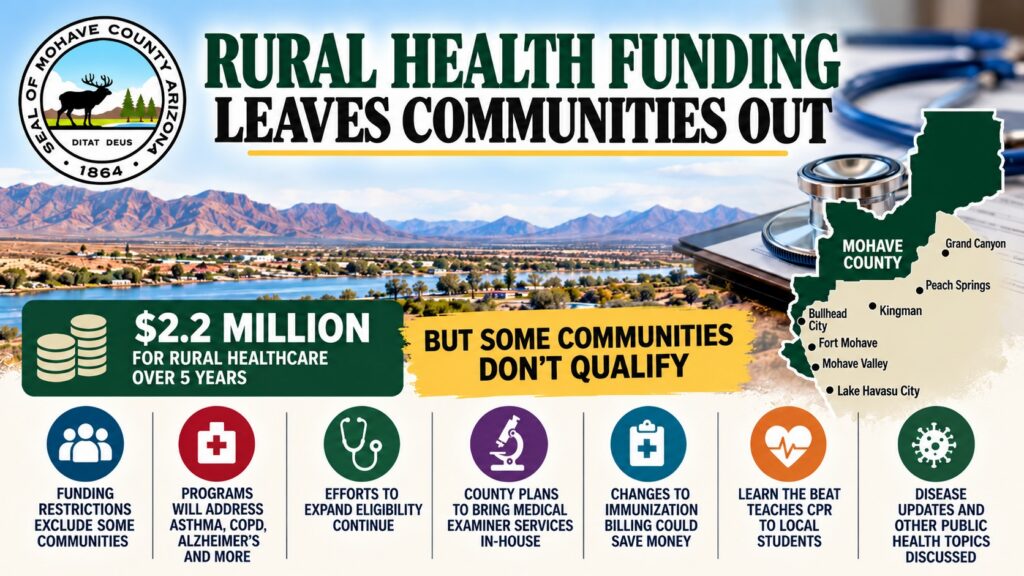
Mohave County could receive nearly $2.2 million over the next five years to improve healthcare in rural communities. But there’s a catch: some communities in the county may not be able to benefit from that money.
The issue was raised during the October 26, 2026, Mohave County Board of Health meeting, where members questioned why communities such as Fort Mohave and Mohave Valley could be excluded from a program designed to address healthcare needs in rural communities.
Assistant Public Health Director Clint Welty explained the Rural Health Transformation Program, a federally funded initiative intended to improve healthcare access in underserved rural areas.
Arizona received approximately $167 million through the program. Mohave County’s initial award is about $543,000, with nearly $2.2 million expected over five years. However, future funding will depend on annual reviews and approval.
The problem is figuring out which communities are eligible. The program follows specific geographic eligibility rules, and those rules have left some parts of Mohave County out.
Bullhead City and Lake Havasu City are already excluded. County officials have also asked the state to include Fort Mohave, but they have yet to receive a response.
Board members questioned why Fort Mohave and Mohave Valley residents might not qualify when they face many of the same healthcare access problems as people living in eligible areas. They also pointed out that the restrictions could leave large portions of three of the county’s five supervisorial districts without access to the program.
Public Health Director Melissa Palmer said the county has already encountered resistance from the state when requesting broader eligibility. Staff are now exploring whether residents in underserved areas could qualify based on their individual home addresses.
Board members asked staff to keep working on the issue. No formal action was taken.
For communities that do qualify, the funding will support programs focused on asthma, chronic obstructive pulmonary disease (COPD), Alzheimer’s disease, and related dementias. Other planned services include expanded health screenings, help connecting residents with healthcare providers, and assistance accessing insurance coverage.
The program will also address congenital syphilis prevention, with an emphasis on better testing, treatment, and connections to medical care.
County Prepares to Bring Medical Examiner Services In-House
The board also heard an update on plans to bring medical examiner services back under county operation.
Palmer reported that construction is underway on a new facility along Horizon Avenue in Kingman. The building will include an autopsy room, refrigeration and freezer space, areas for investigative work, and office space.
The county has started recruiting a manager for the medical examiner services division. Officials plan to begin searching for a forensic pathologist after the first of the year. They also hope to recruit experienced investigators and autopsy technicians to staff the operation.
For now, the county will continue using its existing contracted services through June 30, 2027, giving staff time to prepare for the change.
County Looks at Handling Immunization Billing Internally
The board also discussed how much the county pays for outside billing services.
Nursing Services Manager Lynn Valentine told the board that the county currently pays a third-party billing contractor approximately 40% of applicable administration fees for immunizations.
The department would like to handle billing internally and keep more of that revenue. Valentine said an existing employee would be reassigned to the work, so no additional staff would be needed.
The county has already arranged direct billing with three private insurance companies and is working toward agreements with approximately 15 more.
Supervisor Ron Gould questioned whether the county had calculated the potential savings carefully enough. Eliminating a contractor’s 40% fee might sound like an obvious way to save money, he noted, but the county still needs to account for the cost of doing the work itself.
Valentine also explained that setting up its own billing system is tied to the requirements of the Rural Health Transformation Program.
Learn the Beat Has Taught CPR to More Than 3,200 Students
Not all of the meeting focused on funding and county operations. Board Vice President Sandra Thomas shared an update on Learn the Beat, a program that teaches hands-only CPR to eighth-grade students.
In September alone, 788 students participated. Over the past five years, the program has reached 3,265 students at more than a dozen schools, stretching from Laughlin, Nevada, to Needles, California.
Students are also encouraged to teach two other people what they’ve learned. That way, CPR knowledge doesn’t stop in the classroom. It can reach parents, grandparents, friends, and others in the community.
Firefighters, police officers, emergency medical personnel, healthcare workers, and community volunteers help make the program possible. Thomas said Learn the Beat operates with donated time and support from community sponsors rather than a dedicated operating budget.
Organizers would now like to bring the program to more students in Kingman and Lake Havasu City.
County Reports on Measles, Pertussis and Other Diseases
County Epidemiologist Anna Scherzer provided an update on communicable diseases across Mohave County.
The county’s measles outbreak officially ended in June. Mohave County also experienced a pertussis outbreak in 2025, and some disease counts remain higher than historical levels.
Scherzer did not report any new unusual disease activity requiring special attention. However, with respiratory illness season getting underway, the county will continue tracking influenza, RSV, and COVID-19 cases.
Board members also asked staff to provide sexually transmitted infection rates for the past five years. The request followed a discussion about changes to Arizona’s school sex education laws and whether disease rates had shifted during that period. However, nobody presented evidence showing that the two were connected.
Other topics included obtaining records from previous Board of Health meetings and looking into potential health concerns associated with jet engines used as peaker plants. The board didn’t take any action on either issue.
Before adjourning, members approved the following meeting dates for 2027:
- January 25
- April 26
- July 26
- October 25
Rural Healthcare Funding Questions Remain
For residents of Fort Mohave, Mohave Valley, and other affected communities, the big question is whether they’ll eventually qualify for these healthcare programs. County staff are still looking for answers from the state, but for now, there’s no clear timeline for a decision.
Want to stay informed about what’s happening across the region? Subscribe to the Virgin Valley Voice.
This article was written with the help of AI.
One Response
Hi, this is a comment.
To get started with moderating, editing, and deleting comments, please visit the Comments screen in the dashboard.
Commenter avatars come from Gravatar.